
CLAUDE PARENT
The Oblique Function

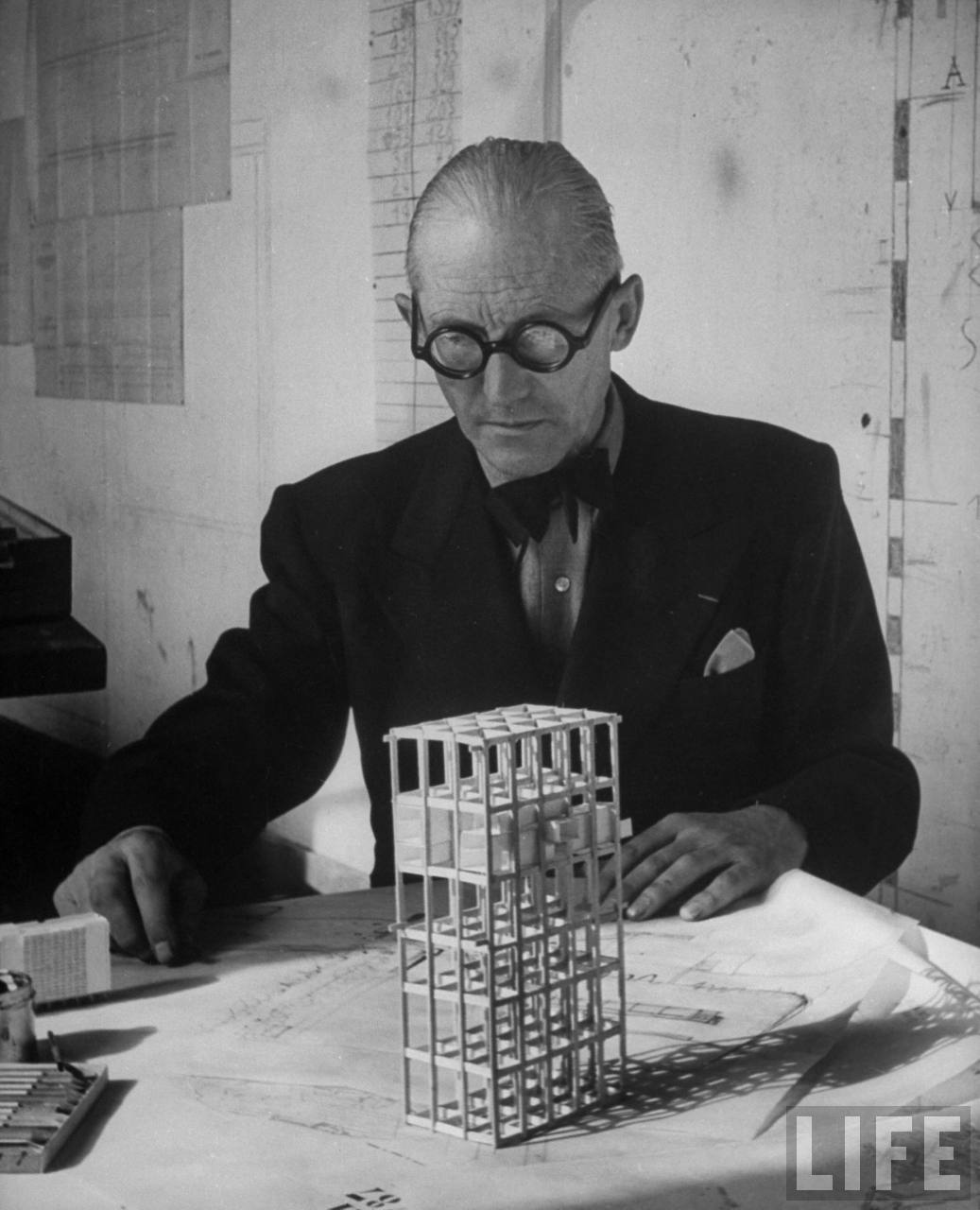
A Visionary Beyond Conventions
Though relatively unknown to the general public, this iconoclastic architect profoundly shaped the field of architecture by challenging its norms, driven by an unrelenting quest: to rethink space, the body, and their interaction. A former student of Le Corbusier, he established his own agency in 1956, where he developed a unique approach far removed from the modernist dogmas of his time.
His influence extends well beyond his built projects. Jean Nouvel, who began his career in Parent’s agency, described him as a man of « impertinent joviality » and « a pertinently sharp pen. » Their bond was highlighted in a 2016 exhibition at the Azzedine Alaïa Gallery (« Musées à venir »), showcasing their shared vision and intellectual lineage.

The "Oblique Function": An Architectural Revolution
In 1963, alongside philosopher Paul Virilio, Claude Parent theorized the « Oblique Function », a concept that would revolutionize architectural design. The idea? Replace static horizontal planes with inclined surfaces, engaging the user’s body in an active relationship with space. More than an aesthetic, it was a philosophy: instability and imbalance became tools to awaken physical and sensory awareness.

His daughter, Chloé Parent, shared her experience of growing up in this unique environment: « Living obliquely is one of the most natural and intelligent ways to inhabit space. It’s dynamic, mobile, and evolutionary. It makes you an accomplice in the architecture you live in, encouraging you to rethink your way of living, heightening your sensitivity to space and others, and ultimately keeping you in shape. »
Today, Jean Nouvel’s Philharmonie de Paris pays tribute to this vision, while works like the Sainte-Bernadette-du-Banlay Church in Nevers (1963–1966)—listed as a Historic Monument in 2000—embody this architectural manifesto. Its interlocking concrete shells and bold volumes invite a physical experience of space.
A Graphic and Human Legacy
Claude Parent was not just a builder; he was also an exceptional draftsman. Loyal to his pencil, he produced thousands of sketches and models, now preserved at the FRAC Centre-Val de Loire. « Learn to say no to the computer, resist its sensual charm, » he advised, advocating for a manual and intuitive approach to creation.
Though his built works were few, they spanned diverse domains:
Private homes (such as the Drusch family house in Versailles, 1963–1965),


Nuclear power plants (Cattenom, Chooz),

Shopping centers (Ris-Orangis, Sens),

Transmission as a Banner
Claude Parent always placed transmission at the heart of his work. He generously responded to requests from young architects, writing prefaces, texts, and recommendations. His handwritten letters, where uppercase and lowercase letters mingled to emphasize the intensity of his words, became legendary.
Parent was constantly drawing to experiment with and communicate the Oblique Function at multiple scales and applications. Parent never stopped drawing, producing hundreds of carefully constructed graphite and ink compositions in which he continued to explore and apply the theories of the Oblique Function to cities, territories, and interiors demonstrating the effect of his ramped architecture on the body. In 2010, Frédéric Migayrou and Francis Rambert curated a major retrospective of Parent’s built and drawn work at the Cité de l’Architecture et du Patrimoine’s inaugural exhibition, introducing the work to a younger generation of architects working primarily with digital drawing techniques.
In 2010, the Cité de l’Architecture et du Patrimoine finally dedicated a retrospective to him, curated by Jean Nouvel. Four years later, Rem Koolhaas paid tribute to him at the Venice Biennale, confirming the lasting impact of his ideas. As Parent himself said: « I don’t want to be an architect. I want to shift the boundaries. »

For Further Exploration
Book: Claude Parent, Visionary Architect (Rizzoli, 2020), edited by his daughter Chloé Parent.
Exhibition: « Claude Parent, l’œuvre construite, l’œuvre graphique » (Hyx/Cité de l’Architecture, 2010).
Iconic Site: Sainte-Bernadette-du-Banlay Church, Nevers.